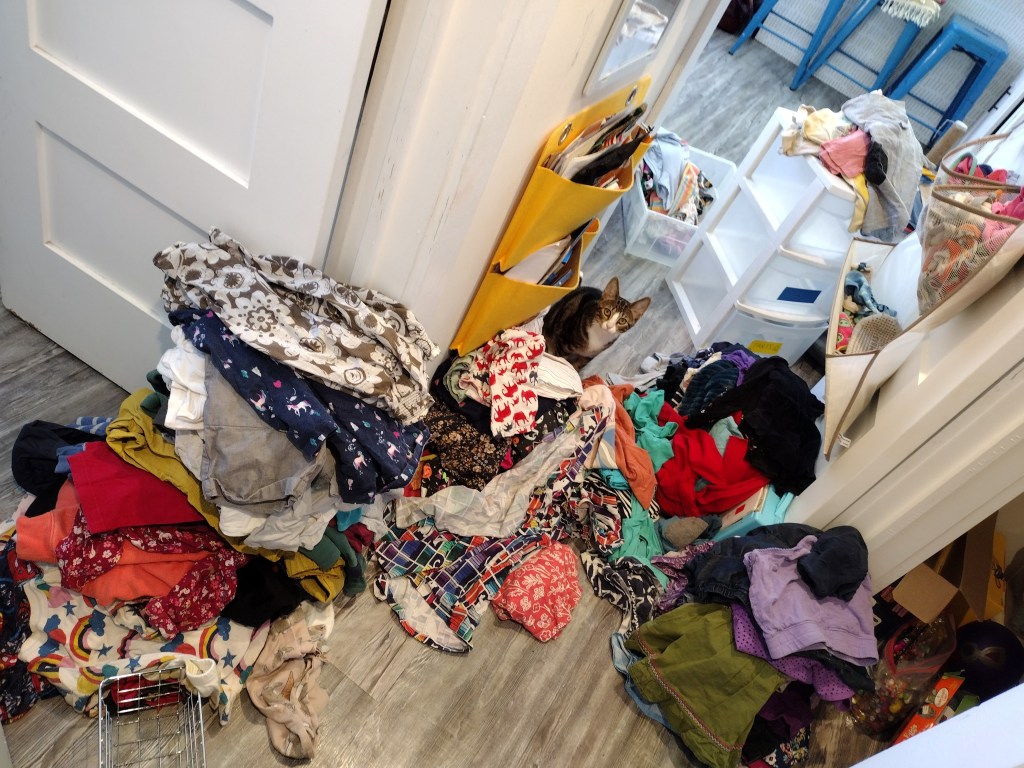
Even the cat is thinking “wtf are you doing, woman??”
Clients often look at me in disbelief – or in abject horror – when I tell them we’re going to dump out the contents of an entire drawer/toolbox/cabinet/closet. Won’t that just make things worse?? they rightfully wonder. The short answer is that yes, yes it will. But only briefly. Because the fact of the matter is that you can’t organize a space without knowing what’s in it. And to know what’s in it, you have to, well, know what’s in it. That means taking everything out. E.V.E.R.Y.T.H.I.N.G. Will it look chaotic? Absolutely. Will it make you feel anxious? Quite possibly. But the good news is that once you’ve taken everything out of a space, you can assess what you’ve got, decide what you need/want to keep, get rid of the rest or move it to a more appropriate spot, and proceed with organizing the items you’re keeping. In fact, once the taking-out-and-sorting-through process is done, the organizing usually falls into place virtually by itself.
I live with three kids in 400 square feet. The kids keep their clothes and games in a single shared closet, and if you’ve ever met children, you can imagine how this closet sometimes looks. Overflowing drawers. Outgrown or unfavored clothes shoved into far corners or cast unceremoniously to the floor. Orphaned puzzle pieces and a teetering tower of board games. Recently the closet reached critical mass. It had become a barely functional anxiety including disaster; something clearly had to be done. I dumped out every single clothing drawer into the hallway. And promptly thought “Well crap, now I’m stuck”. As in, I literally couldn’t move from the hallway until I’d dealt with the chaos I’d created. Where to even start?? Item by item. It was definitely safe to get rid of the 3T shorts the 7 year olds had been squeezing into; those went into the donate pile. A few things went into a sell pile, items I’d paid for that I thought would have high enough resale value to make it worth my while. Items that still fit (and still actually get worn) were sorted into piles by category: leggings, long sleeves, short sleeves, etc. Once everything was culled and sorted, I was able to get a clear picture of what we actually had and assess the storage needs. It turned out that pajamas didn’t need a big drawer, so they were downgraded to a smaller one, while long sleeve shirts – which had previously overflowed from their small drawer – got upgraded to a bigger space. The donation pile got put into a bag and immediately taken to my car (lest it sit and fester in Donation Purgatory), and the sell pile went into a labeled box and moved into my bedroom. I labeled the freshly organized drawers and felt like a freaking rockstar. Almost two hours had passed and I didn’t have the steam to tackle the game shelf, so I only picked up a few straggling game pieces that had landed on the floor and left the project for another day. But the results still felt amazing! Even the kids commented on the change. “Wow, the closet looks great, Mom! I can actually open the drawers now!” “I didn’t realize I had this many pants!” And the best part? I don’t have a sinking feeling in my gut every time I open the closet door.
When it comes to matters of decluttering and organizing, I don’t really believe in rules, because everyone’s needs are a little different, and no two brains work the same way. What works for one person might be a total flop for another. That said, you’ll likely thank yourself if you follow these two guidelines:
1) Only start a project when you have time to complete it in one session. If you leave in the middle, odds are high that things will end up getting hastily shoved aside “just for now” and that will become their new home for a much longer amount of time than you’d probably like. If you only have a small amount of time, only tackle a bite-sized project.
2) Break larger projects, such as entire rooms, into smaller ones. Tempting though it may be, I’d strongly caution against dumping the contents of an entire bedroom or kitchen in one go. The time needed is too great, and the chaos created can lead to paralysis. Instead, tackle one or two areas or categories at a time. In a bedroom, this can look like first addressing all areas that store clothes – closet, dressers, etc – before moving on to other spaces, such as bookshelves. In a kitchen, address one category at a time. For example, you could start with all food items, and once those have been sorted and organized, you can tackle pots/pans/utensils/gadgets. If you complete one category and find that you still have time and energy for a second, go for it! Otherwise, celebrate what you accomplished and set a date (ideally ASAP) for tackling the next category.
It can feel counterintuitive to say that the key to conquering chaos is to create more chaos. But when an area of your home is creating anxiety or has ceased to be functional in the ways you’d like, jumping in with two feet is generally more effective than wading around the edges. That overflowing junk drawer? Dump it out. Yes, it will look like something exploded. But it’s only then that you can decide if you really need three dozen pens, or realize that you possess a mind boggling quantity of dead batteries. Think of it as the storm before the calm. Embrace the chaos, because it’s only a momentary stop on the way to a more orderly, peaceful space.
 The Domestic Doula
Leave a comment