My eldest child’s Lego obsession began at age 4. Within months, our house was crawling with thousands of tiny plastic foot-killers. Pieces were in every room of the house; something had to be done. I marched myself to the nearest big box store, purchased a stack of shoebox-sized plastic containers, and got to work. I was quite pleased with myself: tidy little containers labeled with cardboard cut from the Lego boxes themselves, indicating which type of set was to go in which box. There was a Star Wars box, a Ninjago box, a Lego City box, and so forth. Finally! I’d brought order to the chaos! Except…I hadn’t. It quickly became apparent that my kid had zero interest in playing with Legos the way I’d envisioned. He’d pull several pieces from one box and a handful from another, and then – horror of horrors! – everything was all mixed up and nobody had any idea which piece belonged in which box. Before long, my beautiful labeled containers sat half-empty and abandoned, Legos strewn across the house like before. I was faced with a choice: continue to try to impose my iron organizational will on my son’s play habits, or admit that my system was a failure and come up with Plan B. After a few weeks of the former, I finally came around to the latter. I gathered up the cute little boxes and (after some deep breaths) dumped the contents into a single big bin. And guess what? It worked. When my son was done playing, I could tell him to put away his Legos and he would, because he wasn’t faced with the daunting prospect of sorting everything into multiple bins; he could just gather it all up and go. I’d be lying if I said the new loosey-goosey system didn’t make me twitch a little. But was it better than living with plastic daggers lying all over the floor? Absolutely.
We can be our own worst enemies when it comes to organizing our homes. Without meaning to, we sometimes pick systems that are either too complicated or too vague. When you’ve put an organizational system into place but find that messes are still accumulating, it can be a sign that you need to revisit your system. Is it a great system and you just need to train yourself to use it, or does it need some tweaking? The most ingenious organization system in the world is totally useless if it doesn’t actually work for you; the best system is the one you’ll actually use. Often, the system that works will be the one that’s neither too granular nor too broad. A Goldilocks system, if you will. This applies even more if you have children at home. When evaluating the effectiveness of an organization system, ask yourself the following questions:
- Does the system actually get used?
- Does it feel intuitive?
- Is it clear, or confusing?
- Does it make life easier or more complicated?
- Is there a simpler way I could do this?
- Is it easy to use?
- Does it serve its intended purpose?

If your answers reveal that some changes need to be made, that’s ok! It’s easy to focus on the way a thing should be done at the expense of doing what actually works. Recalibrating isn’t a sign of failure. Organizing our homes involves some (or a lot) of trial and error; flexibility is a strength, not a weakness. Here are some pointers to help you streamline systems that need a bit of help:
Determine your needs
Before taking any action, consider what’s been working and what hasn’t. What seems to be the sticking point(s)? Do you need to do some further decluttering to make more space? Is everything easy to get to, or is something hard to use? Is a system overly broad, making it hard to find what you need?
Keep everything accessible
The more often you use something, the easier it should be to get to. If you have children, are they able to easily reach the storage areas you want them to use? Any obstacles, even something as simple as a drawer that’s hard to open and close, can foil an otherwise great plan, so make sure to keep ease in mind.
Keep it simple
It can be easy to overthink and overspecify our systems, but simpler is often better. I once tried to get my art-loving daughters to use one container for black and blue pens and another for colored pens. In my mind, the distinction made sense. But it was a total flop because it didn’t mesh with the way they actually created art. We ended up combining all the pens into a single container, which was more in line with the way they used the items and also had the happy effect of freeing up a bit of storage space. The easier something is to do, the more likely you and your family will continue to do it!
Use labels
Label label label!! If we don’t know what’s supposed to go where, a system is much harder to use. This is especially true if you live with other people, adults or children. Clearly labeling bins and boxes helps everyone stay on the same page. If you have children who aren’t yet reading, combining pictures or photos with words is extremely useful. Young children aren’t necessarily going to remember that trains go in the red bin, but a container labeled with a big photo of a train is a clear indicator of what’s supposed to go in there. The same is true of boxes that go in our closets or garages; nobody enjoys a game of “what’s in that box?” Clearly label the contents of containers and you’ll thank yourself later when you’re looking for those Halloween decorations or camping supplies.
Get the family involved
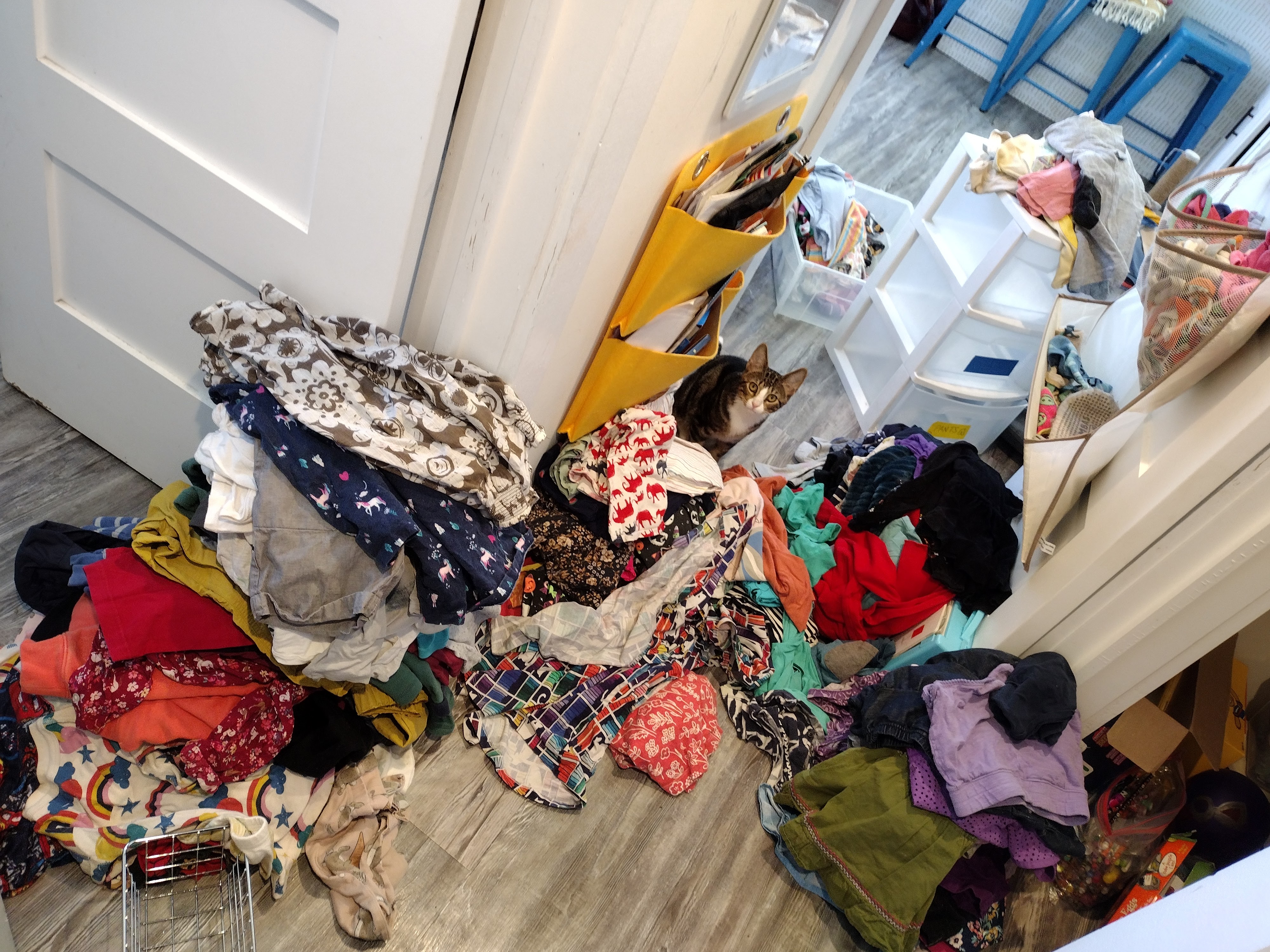
Recently I reorganized my daughters’ room. Clean clothes had started to spill out onto the floor so I knew something needed tweaking. Since they’re old enough to have thoughts and opinions on these things, I checked in with them. It turned out they were having a tough time opening and closing their creaky dresser drawers. We talked about possible solutions and decided to empty out the drawers and put all their clothes in labeled bins on top of the dresser. Because the system had their input and buy-in, they’re much more likely to use it. Plus, it helps them learn to be skilled organizers from an early age!

Ultimately, everyone’s Goldilocks organization strategy will look different. Some kids would have loved my hyper-specific Lego storage system. The secret is to figure out what works for you and your household. Maybe you’ll land on the sweet spot on your first attempt, and maybe you’ll need to try a few things before coming across what works. Give it a bit of time, and you’ll eventually find the bowl of porridge that’s just right.